
Which social platform actually matters in Thailand?
Thailand is one of the most social-first markets in the world — but "being on social" means very different things depending on the platform. Here's how the five main platforms compare, and what each is actually good for.
The five platforms at a glance
| Platform | Users | Time / month | Best for | Watch out for |
|---|---|---|---|---|
| 51M | 16h 23m | Precise ad targeting, trust, official presence | Low organic reach | |
| YouTube | 47.6M | 42h 14m | Explaining a product, long-lived content | Production cost |
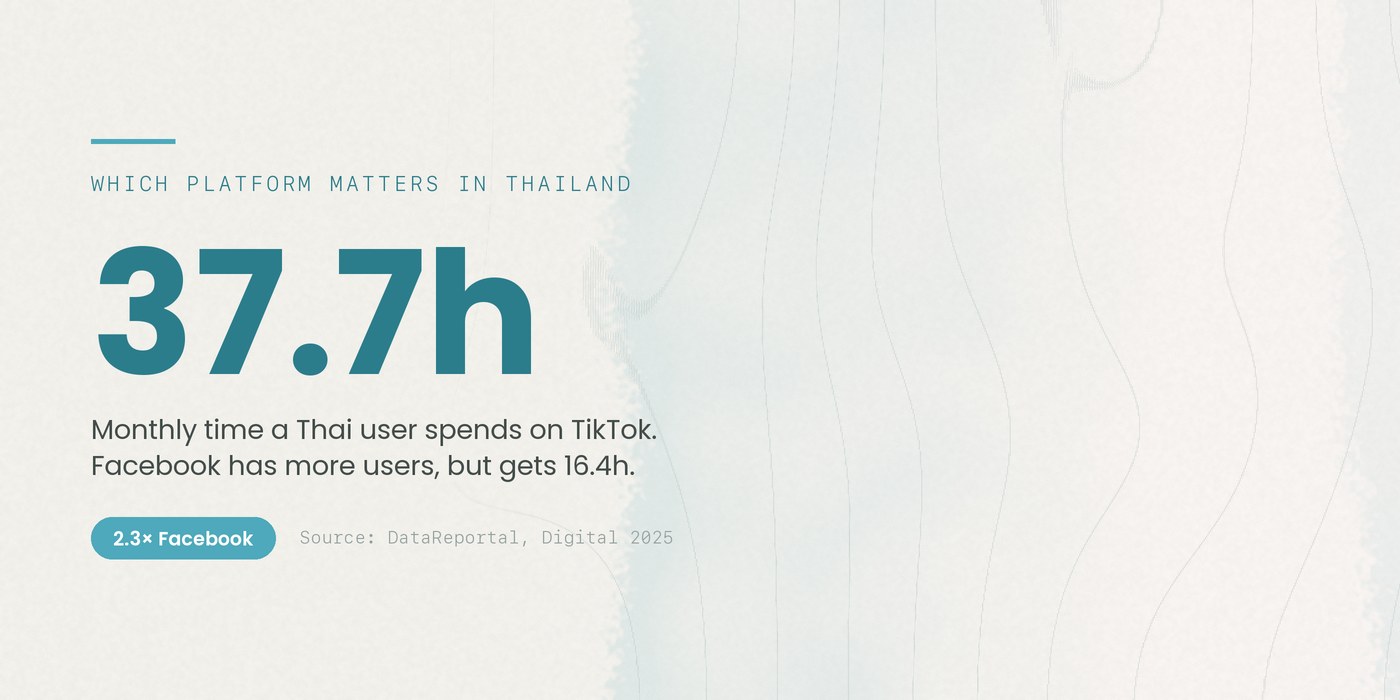
| TikTok | 34M | 37h 40m | Reach beyond followers, discovery, social commerce | Trends move fast |
| 18.5M | 8h 44m | Gen Z, hashtag/search discovery | Smaller audience | |
| X | 13.4M | 2h 53m | Real-time news | Small in Thailand |
Reach isn't the same as attention
Facebook has the largest user base at 51 million, but Thais spend far more time on video: 42 hours a month on YouTube and 37 hours on TikTok, versus 16 hours on Facebook.
If your goal is awareness at scale, reach matters. If your goal is persuasion, time spent is the better signal.
What each platform is good at
Facebook is where official brand presence and precise ad targeting still work best, and it carries trust — but organic content rarely travels.
YouTube is the format for explaining a product properly, and videos keep earning views long after upload. TikTok reaches well beyond your followers, which is what makes a product moment possible at all.
Instagram is the strongest for Gen Z and for being found through search and hashtags. X is small in Thailand and mostly used for real-time news.
Where selling actually happens
Discovery and conversion have collapsed into the same place.
A Thai shopper can meet a product in a video and buy it without leaving the app — which is why creator content, shop operations, and paid amplification now have to be planned as one funnel rather than separate campaigns.
So which one should you use?
Rarely just one. The practical answer depends on your goal: TikTok to create demand, YouTube to explain, Facebook and Instagram to hold the relationship, and paid ads to scale whatever proves it converts.
What matters is deciding upfront which number you're trying to move — then choosing platforms backward from it.
Facebook, at about 51 million users — but Thais spend more time on YouTube (42 hours a month) and TikTok (37 hours) than on Facebook (16 hours).
For most consumer brands, yes — it reaches beyond your existing followers, which is what makes discovery and social commerce possible.